Mormon Missionaries

by Dallin

mormon-missionaries-teachingMembers of The Church of Jesus Christ of Latter-day Saints (often misnamed Mormons) believe that God is the father of all of our spirits. Each of us lived with God, our Heavenly Father, before we were born. Paul wrote, “The Spirit itself beareth witness with our spirit, that we are the children of God” (Romans 8:16). We are all spiritual children of God and are, therefore, brothers and sisters to each other. This is what Mormon missionaries go out to the world to teach.

One reason Latter-day Saints (“Mormons”) build temples is to help each of us, the children of God, to commune with our Heavenly Father and to ultimately qualify ourselves to return to Him after this life. Mormons believe that we can speak to God through prayer and that He answers those prayers by communicating feelings to our hearts and thoughts to our minds, as well as through the actions of others. The reality of our relationship with God and our ability to speak with Him as our Father are two major messages The Church of Jesus Christ of Latter-day Saints shares with the world, sometimes through Mormon missionaries.

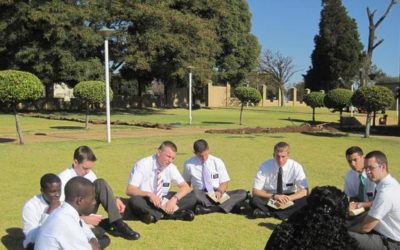
Mormon missionaries are messengers of the gospel of Jesus Christ. These missionaries are usually single young men and women between the ages of 19–26, though couples in their retirement years or older single sisters may also volunteer. The official website of the The Church of Jesus Christ of Latter-day Saints reports that more than 52,480 missionaries are currently volunteering in 340 geographical areas, called missions. Most Mormon missionaries volunteer for a period of 18–24 months.

Mormon missionaries, of The Church of Jesus Christ of Latter-day Saints, are not paid for their extensive service. On the contrary, they are expected to cover their living expenses while serving as full-time volunteers for the Church. Many give up (or at least postpone) scholarships, careers, and other opportunities to volunteer. They come from all over the world and go wherever they are asked to go—from New York to New Delhi.

Once assigned to a mission, a local mission president (also a volunteer) coordinates which missionaries will serve in a given city or region at a given time. Every missionary spends 24 hours of every day with another missionary of the same gender; these duos, called companionships, are assigned by the mission president. Companionships and geographic assignments may be rotated by the mission president every few months.

mormon-missionariesMormon missionaries go wherever they may be assigned, prepared to serve God wholeheartedly. Roughly 90 hours of an average week are dedicated to study, sharing the words of Christ, inviting those interested in the Church to learn more, and helping those around them with everything from yard work to overcoming addiction to disaster cleanup to researching family history.

As part of their weekly routine, Mormon missionaries set aside eight hours to complete any necessary preparations for the coming week. Grocery shopping, laundry, letters or emails to family, and some needed recreation or down time are all completed within these few hours each week.

Missionaries abide by a strict code of conduct. For their 18–24-month term of service, they avoid the entertainment, parties, and dating relationships common to others their age. They are expected to be up by 6:30 in the morning and in bed by 10:30 at night. At least two hours of every morning are devoted to studying the scriptures. Men dress in suits and women in skirts. All missionaries wear black name tags that identify them as servants of God. Other rules, including some cultural boundaries, are designated by the leadership of the Church and the local mission president.

Despite the grueling schedule and what might be seen as a strict code of conduct, Mormon missionary work is also very rewarding. There is great satisfaction in witnessing people—our brothers and sisters—make changes that will improve their lives. Missionaries have helped alcoholics get away from drinking, tense families find harmony, and doubting and depressed hearts find faith and hope through Jesus Christ.

Like the missionaries of the New Testament, Mormon missionaries are instructed to teach, preach, and expound the doctrines of Christ. They testify from their own experiences how God has reached out to them in their lives and answered their prayers. They also testify how they know that God has a plan for each of us, how families can be sealed together through the eternities in holy temples, and how each of us can receive forgiveness and strength through the sacrifice and resurrection of Jesus Christ.

If you’d like to know more about missionaries or their message, they’d be happy to speak with you. Feel free to stop them when you see them to ask whatever questions may be in your heart. If you’d prefer, you can also chat with a missionary online or schedule a time for some missionaries to come by your home. They appreciate the opportunity to share with you, their brother or sister, what our Heavenly Father expects of us and how we can return to our eternal home.

Additional Resources:

Request a free copy of the Book of Mormon (a companion book of scripture to the Bible and another testament of Jesus Christ).

Learn more about Jesus Christ in Mormonism.

Learn more about the history of The Church of Jesus Christ of Latter-day Saints.

dallinDallin Kimble is a member of The Church of Jesus Christ of Latter-day Saints (“Mormon”). He is a devoted husband and father of two, a freelance writer, a leader is his local town and a graduate student of Public Administration at Arizona State University. More of his writing can be found on his blog at principlesofthegospel.blogspot.com.

Posted in About Mormons | Tagged , , , , , , , , | Leave a comment

Mormon Reflection: Medicine and the Gospel

Sarah is a student at Brigham Young University and a member of The Church of Jesus Christ of Latter-day Saints (sometimes called the “Mormon Church” by friends of other faiths). She is currently taking a class where she was asked to write a paper about how the Gospel of Jesus Christ and her specific discipline in school (which is exercise science) are related. Mormons are counseled in modern-day scripture to “seek learning, even by study and also by faith” (Doctrine and Covenants 88:118). She shares her thoughts and feelings concerning this principle below:

Mormon Medicine and the GospelI have chosen to pursue study in the field of medicine. Medicine is principally based on science and research based data. Science itself is seen as a field of study in which there are clear rights and wrongs. Something is fact, or it is not. There is very little room for interpretation of chemical reactions, quantitative results, and physiological and biological processes; however, some explanation can be made in regards to why certain chemical reactions occur, why quantitative results appear how they do, and why physiological and biological processes occur a certain way. Medicine is such a broad and yet vitally important field of study, and many important and ultimately life-saving details can be learned. Incorporating religion and the Gospel of Jesus Christ into the study of medicine can only bring positive results. Continue reading

Posted in About Mormons | Leave a comment

Mormon Beliefs: Living frugally

Mormon Beliefs: Living Frugally, Being Prepared, and Avoiding Debt

Mormon beliefs; frugality

Living frugally is not a strictly Mormon belief or concept, but it is one that is heavily stressed and taught within the Mormon culture and is included in several instructional books for the Church of Jesus Christ of Latter-day Saints (inadvertently called the Mormon church by friends of other faiths). Members who follow the advice and counsel of church leadership to live frugally are often considered thrifty and prepared.

A big part of frugal living is emergency preparedness, and there are often seminars, classes, and activities dedicated to learning how to prepare 72-hour kits and food storage. Such preparedness offers peace-of-mind should there ever be a natural disaster, and we believe it is also an important part of preparing for the second coming of Jesus Christ. However, this isn’t the only benefit. Such preparations leave members prepared to handle smaller personal “disasters” such as facing unemployment in these hard economic times. My parents went through a short period in which my father was unemployed between jobs, and they became heavily reliant on their year supply of food storage. Continue reading

Posted in About Mormons | Tagged , , , , , , , | Leave a comment

What is the Priesthood in Mormonism?

Priesthood of Jesus Christ

Mormon Priesthood authority of Jesus ChristMormons (members of the Church of Jesus Christ of Latter-day Saints) believe in the importance of being “called of God, as was Aaron” before one can ‘hold’ or ‘bear’ the priesthood of God.

The “Mormon” priesthood, a casual designation for the appropriate name, the priesthood of God, or the Aaronic and Melchizedek Priesthood, restored in our day is the ability or right to act in God’s name. Performing the ordinances (or, sacraments) of salvation must be done by those who have the priesthood. Unlike most of our Creedal Christian brothers & sisters, we have a lay ministry, and are not paid for performance of these ordinances. Continue reading

Posted in About Mormons | Tagged , , , , , , | Leave a comment

FLDS is Separate from LDS (Mormons)

Mormons Not FLDS

The general term “Mormonism” can be used to represent members of three different Mormon branches. The largest and most familiar branch is known as the Church of Jesus MormonsChrist of Latter-day Saints, and members of this church often have strong adverse feelings with being associated with the other two branches known as the Reorganized Latter-day Saints and the Fundamentalist Latter-day Saints due to their rejection of the prophets and practice of unseemly traditions. We are, however, connected in our history- Continue reading

Posted in About Mormons | Tagged , , , , , , , , | Leave a comment

Are FLDS People connected to Mormons?

Mormons Not FLDS

The simple answer is ‘no’.

The historically informed and more complete answer is ‘yes, there is a historical connection’. Mormons (members of The Church of Jesus Christ of Latter-day Saints) do not share many of the beliefs of the Fundamentalist Church of Jesus Christ of Latter-day Saints (FLDS) Church, though there are a few that are shared.

MormonsBoth churches believe in the concept of “continuing revelation” — that the heavens are not closed, and that prophets do in reality live today, in our time, and speak for God to all mankind. Both churches also believe that the Book of Mormon is another testament of Jesus Christ, and as such is scripture. This is why FLDS members still consider themselves “Mormons”, which the LDS Church disputes. Continue reading

Posted in About Mormons | Tagged , , , , , , , | Leave a comment

Mormon General Conference

Keith Brown MormonKeith L. Brown is a convert to The Church of Jesus Christ of Latter-day Saints and serves as the Ward Mission Leader in the Annapolis, Maryland Ward.

The General Conference of The Church of Jesus Christ of Latter-day Saints (sometimes inadvertently called the “Mormon Church”) is held during the first weekend in April and the first weekend in October each year. As the Church was founded in April 1830, the April conference is referred to as the Annual General Conference of the Church, whereas the October conference is referred to as the Semiannual General Conference of the Church. The next sessions of General Conference will be held on Saturday, 31 March 2012, and Sunday, 1 April 2012. This will be the 182nd Annual General Conference of The Church of Jesus Christ of Latter Saints. The number of the conference refers to the number of years since the founding of the Church.

Mormon General ConferenceGeneral Conference has been held in Salt Lake City, Utah since 1848 with the exception of the April 1877 Conference which was held in St. George, Utah; in the Salt Lake Tabernacle on Temple Square before 2000 and in the LDS Conference Center after that. Historically, General Conference was over three days with the Annual Conference always including April 6. However, this proved awkward when April 6 fell midweek, as this made conference difficult to attend for those with work and school commitments. In April 1977, during Prophet Spencer W. Kimball‘s Presidency, General Conference was reduced to two days, Saturday and Sunday.

Members of the Church from many different parts of the world will attend Mormon General Conference through various available sources. There will be some members who will travel from great distances to Salt Lake City, Utah, to attend the conference sessions in the LDS Conference Center where the sessions are broadcast via satellite, radio, television, and internet to help increase participation. For those who are unable to get a seat in the Conference Center to view the sessions, the proceedings are broadcast in nearby buildings such as the old Salt Lake Tabernacle or the Joseph Smith Memorial Building via satellite. Other members will gather in meeting houses across the globe to watch the proceedings being broadcast via satellite. Still others will watch via the internet channels that are provided, or in their homes on the BYU television network or KSL television. The Conference is also broadcast on BYU and KSL radio networks. Each session is translated into numerous languages in order that Saints around the world can hear the messages in their own native tongue and be edified and uplifted by the teachings they receive.

President Thomas S. Monson, the current President of The Church of Jesus Christ of Latter-day Saints presides, and either he or one of his counselors conducts each session. Speakers for the sessions of Conference are selected from General and Area Authorities, and auxiliary leaders of the Church. The speakers who are assigned are not given topics on which to speak, but they prayerfully consider what they might speak about and seek the guidance of the Holy Spirit in the preparation of their remarks. Each message that is delivered is both inspirational and instructional, and is considered the will of God to the church members at the current time.

Music is also an important part of the conference in setting the appropriate spiritual mood. The Mormon Tabernacle Choir, accompanied by tabernacle organists generally provides the majority of the music, with the exception of the Saturday afternoon and Priesthood sessions. At the Saturday afternoon session and the Priesthood session guest ensembles include regional choirs, institute choirs, the Missionary Training Center (MTC) choir, and the BYU Choirs. The hymns are usually selected from the normal repertoire of LDS hymns and their various arrangements, with an occasional piece from traditional sacred choral repertoire. Usually, the congregation is invited to stand and join in with one hymn halfway through each session.

Mormon General ConferenceEach session of conference is two hours in length. On Saturday there is a morning session followed by a two hour recess, an afternoon session, followed by a two hour recess, and a Priesthood session is held on Saturday evening for all men and boys (12 years of age and older) who are members of the Priesthood. On Sunday there is a morning session followed by a two hour recess, and then a concluding session on Sunday afternoon. The sessions of General Conference are not restricted only to members of the Church, but non-member family and friends, as well as, those who are in the process of learning more about the Church are also invited to attend.

At the beginning of General Conference, President Thomas S. Monson, the current President of the Church (also considered by the members to be the Prophet, Seer, and Revelator), welcomes the members and makes several announcements to include the construction of new Temples. Part of the proceedings of General Conference also includes proposing changes to Church leadership and those changes are sustained through the principle of common consent. The April meeting includes annual statistical and financial reports not included in the October meeting.

On the weekend prior to General Conference, under the direction of the First Presidency of the Church, either the Young Women General Presidency (in the month of April) or the Relief Society General Presidency (in the month of October) hold their annual meeting for all young women of the Church, and all members of the Relief Society respectively. The next General Young Women’s meeting is scheduled for Saturday, 24 March 2012.

Additional Resources:

Basic Mormon Beliefs and Real Mormons

Jesus Christ in Mormonism

The Bible in Mormonism


General Conference addresses are published in many text, video, and audio formats in multiple languages and multiple channels, including television, radio, the internet, and other media, such as the ROKU device. Those who are unable to attend or watch General Conference during conference weekend are afforded the opportunity to watch the sessions via the internet on the Church’s official website LDS.ORG. The texts of the messages that are given are made available in the official Church magazines, the Ensign and the Liahona (in over 30 languages), within 4 to 6 weeks, and can generally be found on the Conference website in English within 4 days and in over 40 other different languages within 2 to 8 weeks following General Conference. Video of the conference messages are usually available on the Conference website and the Mormon Channel on YouTube (in ASL, Cantonese, English, French, German, Italian, Japanese, Korean, Mandarin, Portuguese, Russian, and Spanish) within 24 hours, on mobile devices and the Mormon Channel on ROKU within 1 week following General Conference. General Conference is also recorded on DVDs which are generally available 6 weeks after the conference.


As members of the Church of Jesus Christ meet together for General Conference twice a year, they know that they are going to be taught by the Prophet of the Lord, modern day Apostles, and other leaders of the Church. They know that each message has been prayerfully prepared, and that the things that they will be taught and learn will help to strengthen their personal testimonies and daily walk with their Lord and Master, Jesus Christ.

Enhanced by Zemanta
Posted in About Mormons | Tagged , , , , | Leave a comment

Mormon Tabernacle Choir Members are Musical Missionaries

 by Mike Taylor

The Mormon Tabernacle Choir

Many members of the Church of Jesus Christ of Latter-day Saints (commonly known as Mormons) are called as missionaries. Members of the world-famous Mormon Tabernacle Choir and The Orchestra At Temple Square are all volunteer missionaries. They are called to bear their testimonies of the truthfulness of the gospel of Jesus Christ to the world, and are blessed in their callings.

My sweet sister, Susan, was a member of the Mormon Tabernacle Choir for twenty years. She volunteered to become a member of that group and traveled the world. Once while the choir was on tour she fell and seriously cut her leg. Elder Russell M. Nelson, a physician who was also an Apostle of The Church of Jesus Christ of Latter-day Saints, was on tour with the choir at that time and was able to stitch up the gash. She was able to continue on the tour. She said that she had many spiritual experiences come to her as she sang in the choir.

Susan suffered from multiple sclerosis most of the time that she was in the choir, making attending the practices difficult for her. Her husband always supported her in her efforts to make each practice and performance. I asked her if she would rather have not been in the choir if she could have found a way to share her talent of singing some other way. She calmly replied that the years she volunteered her service in the choir were the some of the best years of her life.

My uncle Reed served as a volunteer member of the Choir for nearly 30 years. He said of his time on the choir, “Those times were demanding, and I was away from my family often, but the times that I was able to contribute to the mission of the choir were priceless. My family was blessed as I served.”

Additional Resources:

Called To Sing: Tabernacle Choir Members are Musicians Who Have a Mission

Mormon Tabernacle Choir Official Website

Music and the Spoken Word Website


Enhanced by Zemanta
Posted in About Mormons | Tagged , , , , , , , , , , | Leave a comment

Mormon Woman Profile

Athelia Woolley LeSueur is a successful fashion designer in NYC and she and her husband are expecting their first baby; but life wasn’t always so bliss. She used to be an avid dancer, but as she kept working harder in dance she realized her body became more weak. Finally she was diagnosed with an autoimmune disorder that would forever impact her life. She chose faith over fear and is continuing to triumph over her trials. So yes, Athelia is a member of The Church of Jesus Christ of Latter-day Saints, also known as a “Mormon”. Read her story and watch her video below:

About Me

Mormon woman

I am a fashion designer. I live and work in New York City. I have loved clothes for as long as I can remember. Now I love my job too! Before becoming a designer, I was a modern dancer, counselor and neuroscience lab analyst. I married in my 30’s and am expecting my first child. I’m having a girl and can’t wait to design clothes for her!

Why I am a Mormon

I am a Mormon because I have had deeply personal and sacred spiritual experiences with God. Through these experiences, I have learned of the truthfulness of the Book of Mormon. I have also come to know that the principles that are taught in the Book of Mormon are true principles. The more I live them, the better my life. In short, being a Mormon makes me happy.

Continue reading

Posted in About Mormons | Leave a comment

A Mormon Girl’s Streetside Prayer

By Jan Mayer, a member of The Church of Jesus Christ of Latter-day Saints .  As a “Mormon woman,” Jan is a graduate of BYU and mother of five children. She has written for numerous publications,  including The Denver Post, The Villager and NorthStar.

It must have been strange to see me–a 10- year old girl– kneeling on a lawn next to a busy street. It was on the long walk home from school that I wondered if I could talk to Heavenly Father at any time, like my Sunday School Teacher said. Although I had prayed many times at home and at meetings of The Church of Jesus Christ of Latter-day Saints, it had never felt this personal before.

Busy street Mormon prayerOn that day, I told Heavenly Father that I was embarrassed to kneel out in the open, that I wasn’t sure what to say. Then, seeking for some purpose, I prayed to get home safely…feeling dumb because of course, I would get home safely…it was only a few blocks and I’d been safe every other day.

A simple child’s prayer—yet the impact has endured through my life. At that moment, I didn’t comprehend what I had learned, but from that day forward, I knew Heavenly Father would listen and that I mattered to Him–no matter where I was or what I was doing. I understood that I didn’t have to kneel down in a public place to have a prayer in my heart. Since then, I have had an ongoing conversation with Heavenly Father.

Armed with that knowledge, I have never felt abandoned in the battles of life, no matter how bitter. To have a constant prayer in my heart and mind has helped me maintain a happier attitude and sense of peace.

Although there have been times I’ve forgotten or withdrawn, I have always gone back to what I know. Realizing you are understood by Him–when no one else “gets” you–makes the intolerable tolerable. And when things just seem too hard, His love wraps you in warmth and comfort that can not be found any other way.

Related scriptures:

Psalms 17:6-7

Phillippians 4:6-7

2 Nephi 32:9

Additional Resources:

The Meaning of Life

Basic Beliefs and Real Mormons

Our Search for Happiness


Enhanced by Zemanta
Posted in About Mormons, Mormon Beliefs: Christian Values | Tagged , , , , , , , , | Leave a comment